





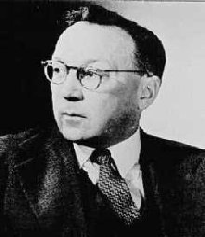
That appeared to satisfy my curiosity at that time and it was a number of years later that a good friend of mine, a St Andrews University Graduate from our village, when I asked what he was now doing, replied that he was working at the Royal Aircraft Establishment at Farnborough designing the nose cone of Concorde to house its radar installation. My curiosity about radar was therefore further aroused. By that time I knew that the system used a cathode ray tube of a similar type found in Televisions, which in the 1950’s and 1960’s were becoming more profuse, and that radio waves formed part of the process. In recent years, the BBC Television has put out a number of programmes about radar. In particular, I noticed in October 2006, an international fund-raising appeal has been launched to commemorate the generally accepted father of radar, Sir Robert Watson-Watt (above) with a £50,000 memorial that will be erected in his hometown of Brechin in Angus. “The Courier”, a Scottish daily newspaper based in Dundee a few miles from Brechin recently commented in an article regarding the setting up of the charitable trust and the launch of an international fund-raising appeal by the Watson-Watt Society of Brechin that “The pioneering work on the detection of aircraft by radio methods undertaken by Watson-Watt resulted in the design and installation of a chain of radar stations along the east coast of England in time for the outbreak of the second world war. The system provided the vital advance information that helped the RAF win the Battle of Britain and was essential in the Battle of the Atlantic and critical in the D-Day invasion.” He is arguably the most distinguished electrical engineer of the 20th Century and here again, like radar, my knowledge of him was woefully lacking in substance. Radar and Sir Robert Watson-Watt’s work was top secret during the war and this is probably one of the reasons knowledge was so scant. However, a bit of personal research has produced some most fascinating, interesting and comprehensive information on the history of radar in general and Sir Robert Watson-Watt in particular.
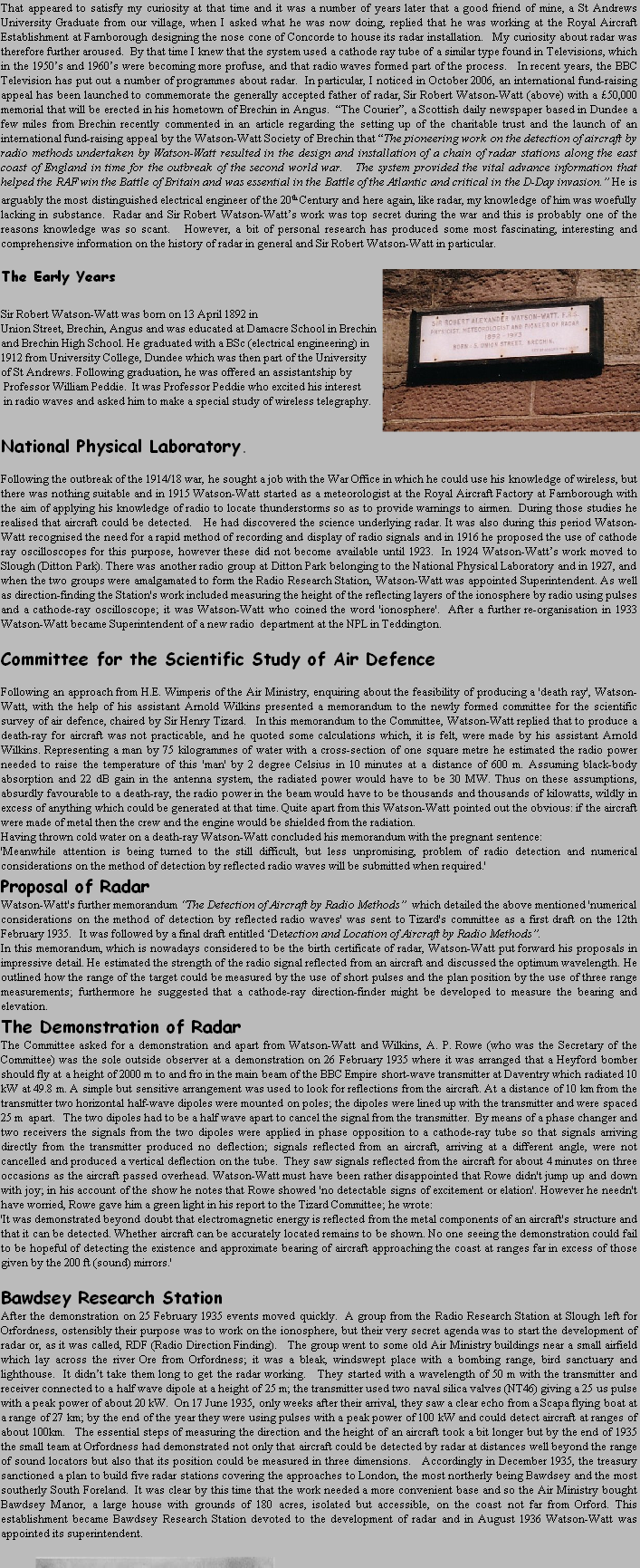
The Early Years
Sir Robert Watson-Watt was born on 13 April 1892 in
Union Street, Brechin, Angus and was educated at Damacre School in Brechin
and Brechin High School. He graduated with a BSc (electrical engineering) in
1912 from University College, Dundee which was then part of the University
of St Andrews. Following graduation, he was offered an assistantship by
Professor William Peddie. It was Professor Peddie who excited his interest
in radio waves and asked him to make a special study of wireless telegraphy.
National Physical Laboratory.
Following the outbreak of the 1914/18 war, he sought a job with the War Office in which he could use his knowledge of wireless, but there was nothing suitable and in 1915 Watson-Watt started as a meteorologist at the Royal Aircraft Factory at Farnborough with the aim of applying his knowledge of radio to locate thunderstorms so as to provide warnings to airmen. During those studies he realised that aircraft could be detected. He had discovered the science underlying radar. It was also during this period Watson-Watt recognised the need for a rapid method of recording and display of radio signals and in 1916 he proposed the use of cathode ray oscilloscopes for this purpose, however these did not become available until 1923. In 1924 Watson-Watt’s work moved to Slough (Ditton Park). There was another radio group at Ditton Park belonging to the National Physical Laboratory and in 1927, and when the two groups were amalgamated to form the Radio Research Station, Watson-Watt was appointed Superintendent. As well as direction-finding the Station's work included measuring the height of the reflecting layers of the ionosphere by radio using pulses and a cathode-ray oscilloscope; it was Watson-Watt who coined the word 'ionosphere'. After a further re-organisation in 1933 Watson-Watt became Superintendent of a new radio department at the NPL in Teddington.
Committee for the Scientific Study of Air Defence
Following an approach from H.E. Wimperis of the Air Ministry, enquiring about the feasibility of producing a 'death ray', Watson-Watt, with the help of his assistant Arnold Wilkins presented a memorandum to the newly formed committee for the scientific survey of air defence, chaired by Sir Henry Tizard. In this memorandum to the Committee, Watson-Watt replied that to produce a death-ray for aircraft was not practicable, and he quoted some calculations which, it is felt, were made by his assistant Arnold Wilkins. Representing a man by 75 kilogrammes of water with a cross-section of one square metre he estimated the radio power needed to raise the temperature of this 'man' by 2 degree Celsius in 10 minutes at a distance of 600 m. Assuming black-body absorption and 22 dB gain in the antenna system, the radiated power would have to be 30 MW. Thus on these assumptions, absurdly favourable to a death-ray, the radio power in the beam would have to be thousands and thousands of kilowatts, wildly in excess of anything which could be generated at that time. Quite apart from this Watson-Watt pointed out the obvious: if the aircraft were made of metal then the crew and the engine would be shielded from the radiation.
Having thrown cold water on a death-ray Watson-Watt concluded his memorandum with the pregnant sentence:
'Meanwhile attention is being turned to the still difficult, but less unpromising, problem of radio detection and numerical considerations on the method of detection by reflected radio waves will be submitted when required.'
Proposal of Radar
Watson-Watt's further memorandum “The Detection of Aircraft by Radio Methods” which detailed the above mentioned 'numerical considerations on the method of detection by reflected radio waves' was sent to Tizard's committee as a first draft on the 12th February 1935. It was followed by a final draft entitled ‘Detection and Location of Aircraft by Radio Methods”.
In this memorandum, which is nowadays considered to be the birth certificate of radar, Watson-Watt put forward his proposals in impressive detail. He estimated the strength of the radio signal reflected from an aircraft and discussed the optimum wavelength. He outlined how the range of the target could be measured by the use of short pulses and the plan position by the use of three range measurements; furthermore he suggested that a cathode-ray direction-finder might be developed to measure the bearing and elevation.
The Demonstration of Radar
The Committee asked for a demonstration and apart from Watson-Watt and Wilkins, A. P. Rowe (who was the Secretary of the Committee) was the sole outside observer at a demonstration on 26 February 1935 where it was arranged that a Heyford bomber should fly at a height of 2000 m to and fro in the main beam of the BBC Empire short-wave transmitter at Daventry which radiated 10 kW at 498 m. A simple but sensitive arrangement was used to look for reflections from the aircraft. At a distance of 10 km from the transmitter two horizontal half-wave dipoles were mounted on poles; the dipoles faced the transmitter and were spaced 5 m apart in that direction. By means of a phase changer and two receivers the signals from the two dipoles were applied in phase opposition to a cathode-ray tube so that signals arriving directly from the transmitter produced no deflection; signals reflected from an aircraft, arriving at a different angle, were not cancelled and produced a vertical deflection on the tube. They saw signals reflected from the aircraft for about 4 minutes on three occasions as the aircraft passed overhead. Watson-Watt must have been rather disappointed that Rowe didn't jump up and down with joy; in his account of the show he notes that Rowe showed 'no detectable signs of excitement or elation'. However he needn't have worried, Rowe gave him a green light in his report to the Tizard Committee; he wrote:
'It was demonstrated beyond doubt that electromagnetic energy is reflected from the metal components of an aircraft's structure and that it can be detected. Whether aircraft can be accurately located remains to be shown. No one seeing the demonstration could fail to be hopeful of detecting the existence and approximate bearing of aircraft approaching the coast at ranges far in excess of those given by the 200 ft (sound) mirrors.'
Bawdsey Research Station
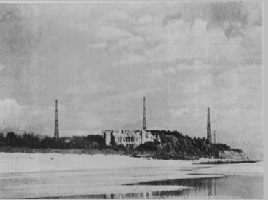
After the demonstration on 25 February 1935 events moved quickly. A group from the Radio Research Station at Slough left for Orfordness, ostensibly their purpose was to work on the ionosphere, but their very secret agenda was to start the development of radar or, as it was called, RDF (Radio Direction Finding). The group went to some old Air Ministry buildings near a small airfield which lay across the river Ore from Orfordness; it was a bleak, windswept place with a bombing range, bird sanctuary and lighthouse. It didn’t take them long to get the radar working. They started with a wavelength of 50 m with the transmitter and receiver connected to a half wave dipole at a height of 25 m; the transmitter used two naval silica valves (NT46) giving a 25 us pulse with a peak power of about 20 kW. On 17 June 1935, only weeks after their arrival, they saw a clear echo from a Scapa flying boat at a range of 27 km; by the end of the year they were using pulses with a peak power of 100 kW and could detect aircraft at ranges of about 100km. The essential steps of measuring the direction and the height of an aircraft took a bit longer but by the end of 1935 the small team at Orfordness had demonstrated not only that aircraft could be detected by radar at distances well beyond the range of sound locators but also that its position could be measured in three dimensions. Accordingly in December 1935, the treasury sanctioned a plan to build five radar stations covering the approaches to London, the most northerly being Bawdsey and the most southerly South Foreland. It was clear by this time that the work needed a more convenient base and so the Air Ministry bought Bawdsey Manor, a large house with grounds of 180 acres, isolated but accessible, on the coast not far from Orford. This establishment became Bawdsey Research Station devoted to the development of radar and in August 1936 Watson-Watt was appointed its superintendent.