




Childhood Memories of St Monans
I left my home village of St Monans when I was 18 and return there for visits as often as I can. I feel this is another of the more obscure hobbies in which I am accused of indulging. Most people consider the place of their birth and probably where they have spent their formative years to be a very special and emotional place in their heart. T.S. Eliot wrote ”home is where one starts”. And so it was and still is with me.
Now that I am into my seventies, there are so many memories of St Monans, I felt that I had to get a few of those recorded even if it was just for my own amusement but also for my entail since my children and grand-children are scattered all over the United Kingdom and none have settled into my beloved birthplace.
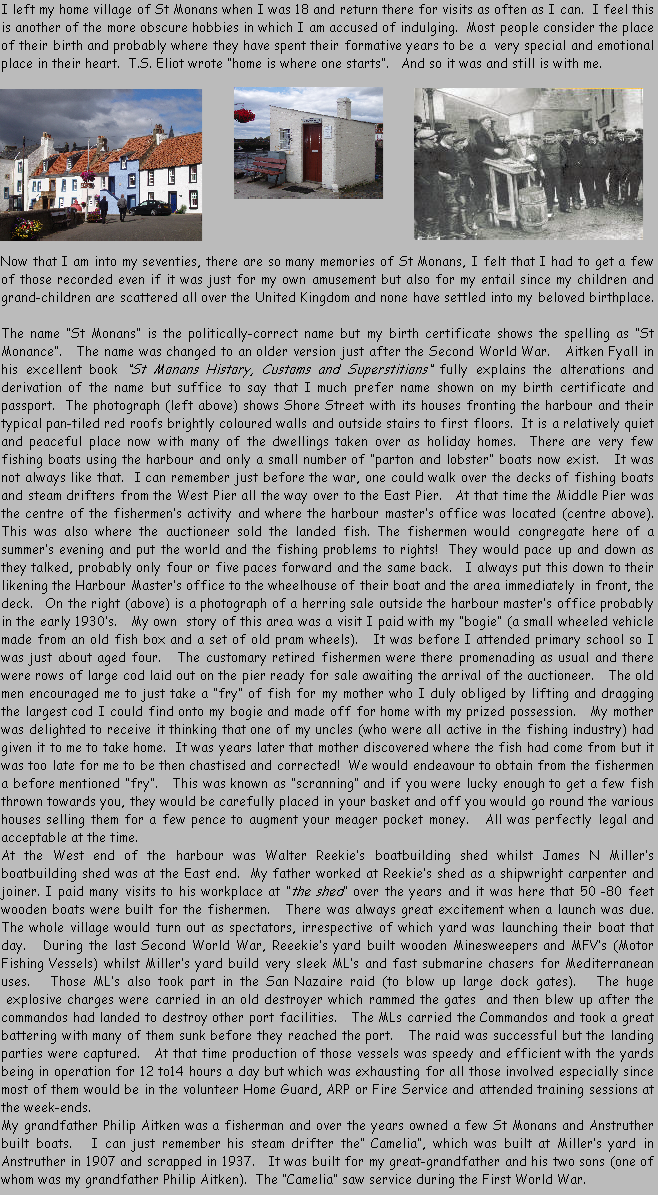
The name “St Monans” is the politically-correct name but my birth certificate shows the spelling as “St Monance”. The name was changed to an older version just after the Second World War. Aitken Fyall in his excellent book “St Monans History, Customs and Superstitions” fully explains the alterations and derivation of the name but suffice to say that I much prefer name shown on my birth certificate and passport. The photograph (left above) shows Shore Street with its houses fronting the harbour and their typical pan-tiled red roofs brightly coloured walls and outside stairs to first floors. It is a relatively quiet and peaceful place now with many of the dwellings taken over as holiday homes. There are very few fishing boats using the harbour and only a small number of “parton and lobster” boats now exist. It was not always like that. I can remember just before the war, one could walk over the decks of fishing boats and steam drifters from the West Pier all the way over to the East Pier. At that time the Middle Pier was the centre of the fishermen’s activity and where the harbour master’s office was located (centre above). This was also where the auctioneer sold the landed fish. The fishermen would congregate here of a summer’s evening and put the world and the fishing problems to rights! They would pace up and down as they talked, probably only four or five paces forward and the same back. I always put this down to their likening the Harbour Master’s office to the wheelhouse of their boat and the area immediately in front, the deck. On the right (above) is a photograph of a herring sale outside the harbour master’s office probably in the early 1930’s. My own story of this area was a visit I paid with my “bogie” (a small wheeled vehicle made from an old fish box and a set of old pram wheels). It was before I attended primary school so I was just about aged four. The customary retired fishermen were there promenading as usual and there were rows of large cod laid out on the pier ready for sale awaiting the arrival of the auctioneer. The old men encouraged me to just take a “fry” of fish for my mother who I duly obliged by lifting and dragging the largest cod I could find onto my bogie and made off for home with my prized possession. My mother was delighted to receive it thinking that one of my uncles (who were all active in the fishing industry) had given it to me to take home. It was years later that mother discovered where the fish had come from but it was too late for me to be then chastised and corrected! We would endeavour to obtain from the fishermen a before mentioned “fry”. This was known as “scranning” and if you were lucky enough to get a few fish thrown towards you, they would be carefully placed in your basket and off you would go round the various houses selling them for a few pence to augment your meager pocket money. All was perfectly legal and acceptable at the time.
At the West end of the harbour was Walter Reekie’s boatbuilding shed whilst James N Miller’s boatbuilding shed was at the East end. My father worked at Reekie’s shed as a shipwright carpenter and joiner. I paid many visits to his workplace at “the shed” over the years and it was here that 50 -80 feet wooden boats were built for the fishermen. There was always great excitement when a launch was due. The whole village would turn out as spectators, irrespective of which yard was launching their boat that day. During the last Second World War, Reeekie’s yard built wooden Minesweepers and MFV’s (Motor Fishing Vessels) whilst Miller’s yard build very sleek ML’s and fast submarine chasers for Mediterranean uses. Those ML’s also took part in the San Nazaire raid (to blow up large dock gates). The huge explosive charges were carried in an old destroyer which rammed the gates and then blew up after the commandos had landed to destroy other port facilities. The MLs carried the Commandos and took a great battering with many of them sunk before they reached the port. The raid was successful but the landing parties were captured. At that time production of those vessels was speedy and efficient with the yards being in operation for 12 to14 hours a day but which was exhausting for all those involved especially since most of them would be in the volunteer Home Guard, ARP or Fire Service and attended training sessions at the week-ends.
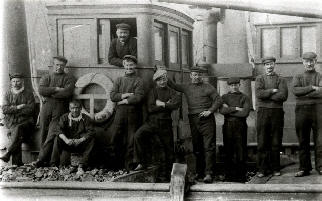
My grandfather Philip Aitken was a fisherman and over the years owned a few St Monans and Anstruther built boats. I can just remember his steam drifter the” Camelia”, which was built at Miller’s yard in Anstruther in 1907 and scrapped in 1937. It was built for my great-grandfather and his two sons (one of whom was my grandfather Philip Aitken). The “Camelia” saw service during the First World War.
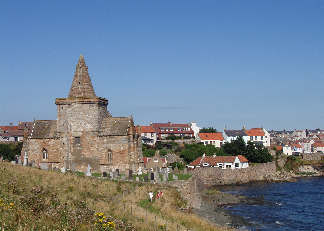
In the main for fishermen and boatbuilders Sunday was a day of rest with the wartime auxiliary services training taking place after the church services or on Saturday. St Monans was of course a very religious place having many places of worship ranging from the main Church, the Church of Scotland, the Free Church, the Congregational Church, the Salvation Army and many meeting rooms for a number of Brethren and other followers. The large number of religious establishments gave rise to the village being known as “The Holy City” The picture below is of St Monance Parish Church, the oldest church in Scotland still in regular use. Known as “The Auld Kirk”, it is reputedly built by King David II, Son of King Robert The Bruce, after being shipwrecked nearby. It was thought to have been completed in 1369. But again, please refer to Aitken Fyall’s excellent book “St Monans History Customs and Superstitions” for full and detailed information. This was where I was christened, where my father was an Elder, where I was a member of the Choir and which generally had a great effect on the formative years of my life.


However, next morning as we assembled at the primary school, my friend Robert and I were extracted from the line to be spoken to by the Headmaster ( a very series occurrence in those days) to ensure that similar hilarity didn’t happen in the future! It never did, but so reminded me throughout my life when I read or heard our national bard Robert Burn’s poems “To a Mouse, on turning up her Nest with the Plough, November 1785” or “To a Louse, on seeing one on a Lady’s Bonnet in Church”

It was whilst attending a service at the church when aged about 8 or 9 and sitting with my friend Robert that we noticed when a discarded sweet paper (always used to help the long Minister’s sermon pass a bit quicker) was placed on a small stone plinth adjoining our pew, that the piece of paper suddenly disappeared. This happened on a number of occasions until we noticed a nose of a small mouse protrude from the hole, presumably looking for more sweet papers! Of course this caused great hilarity to the pair of us for the rest of the sermon. Unfortunately for us the headmaster at our school Wilfred Skelding was sitting in the pew in front of us and didn’t appear to be upset by our antics.
The 14th Century Auld Kirk
of St Monans
Grandad is shown here (on the right) in the wheelhouse of the “Camelia” with his crew again probably in the early 1930s’.